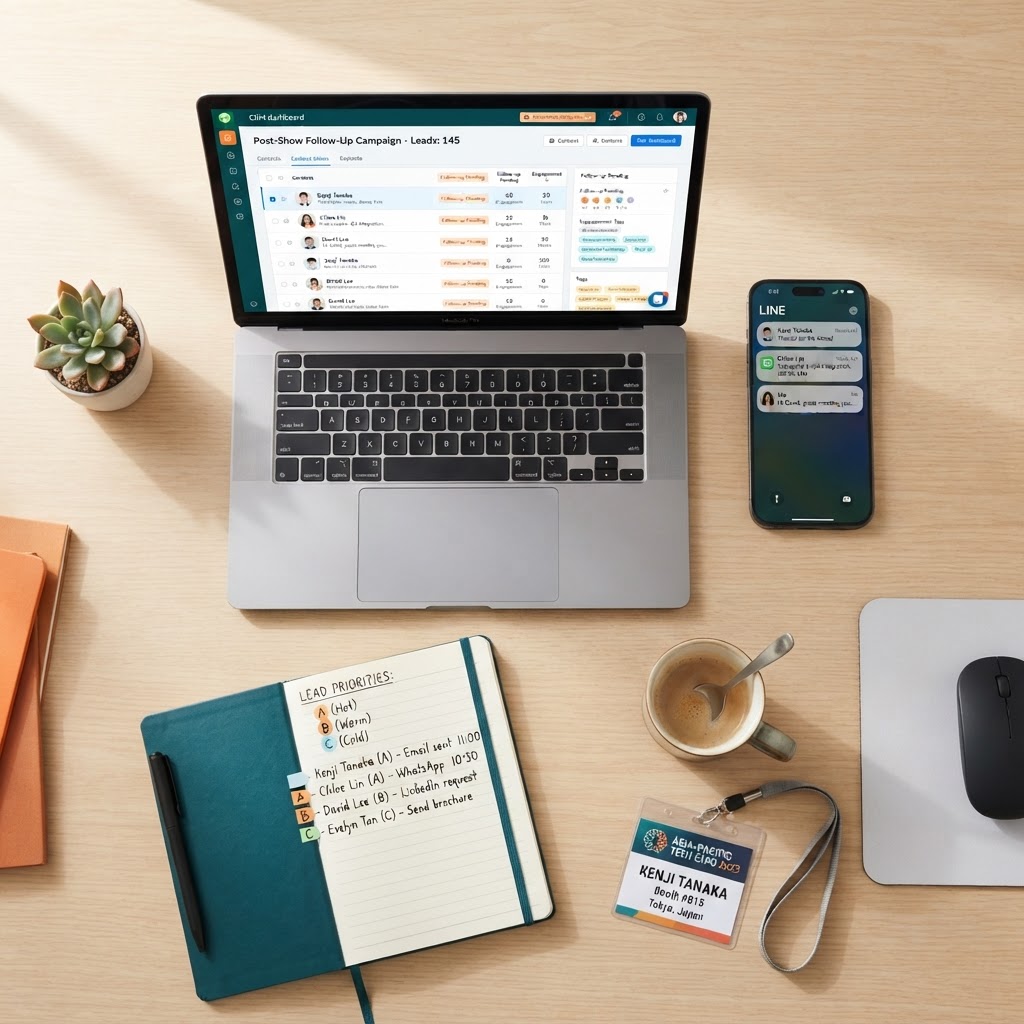
Post-Show Follow-Up Strategy: Turning Trade Show Leads into Clients in Asia
The exhibition is over. Your booth is packed away, your team is exhausted, and the leads are sitting in a spreadsheet or a lead-capture app. What happens in the next 72 hours will determine whether your trade show investment pays off or becomes an expensive learning experience.
Studies consistently show that most exhibitors fail to follow up with the majority of their trade show leads. Some never follow up at all. For overseas exhibitors in Asia, the challenge is even greater: time zone differences, language barriers, cultural communication preferences, and the sheer volume of contacts collected over several busy days can turn follow-up into a bottleneck.
This guide breaks down a practical post-show follow-up strategy designed for overseas exhibitors who have just exhibited at a trade show in Asia. It covers what to do before you leave the venue, how to segment your leads, when to make first contact, which channels to use by country, and how to keep the conversation going until the lead becomes a client.
Before You Leave the Venue
Good follow-up starts before the show ends. While your team is still on the show floor, take 15 minutes at the end of each day to do the following:
Tag Every Lead While It Is Fresh
If you are using a lead-capture app (BadgeScan, ME Scan, Global Traqe, or the organiser s own system), make sure each scanned lead has a qualitative note attached. A bare QR scan gives you a name and email, but nothing about why that person stopped at your booth.
Train your staff to add a short note and a rating before the visitor walks away:
- A — Hot: Ready to buy or request a quotation, has budget and timeline, asks for a meeting.
- B — Warm: Interested in the product, wants a catalogue or more information, may buy within 3 to 6 months.
- C — Cold: Casual visitor, student, researcher, or competitor. Took a brochure out of politeness.
This simple A/B/C tag takes five seconds to add and saves hours of sorting later.
Capture the Preferred Channel
In Asia, the preferred communication channel varies dramatically by country. Ask each serious lead how they would like to be contacted:
- Singapore: Email and LinkedIn
- Malaysia & Indonesia: WhatsApp (by far the most used business channel)
- Thailand: LINE (dominant messaging app)
- Vietnam: Zalo (70 million+ users) and email
- China: WeChat (if you are also targeting Chinese visitors)
- Japan & Korea: Email and LINE
Write the channel on the lead record. If someone gives you their WhatsApp number, do not send them an email. If they use LINE, add them on LINE. Meeting people on their preferred platform dramatically increases response rates.
Export and Back Up Before You Fly Home
Do not wait until you are back in the office to export your leads. Network connectivity, app subscriptions, and organiser access can expire after the show ends. Export all captured leads to a CSV or Excel file each evening and store it in a shared cloud folder (Google Drive, Dropbox, OneDrive). This protects against data loss and lets your sales team start working the list before you have even landed.
The 72-Hour Rule
Once you are back at your desk, the clock is ticking. Research from the Center for Exhibition Industry Research (CEIR) shows that leads contacted within the first 48 to 72 hours after a trade show have a significantly higher conversion rate than those contacted a week or more later.
Here is a practical timeline:
Day 1 to 2: The Thank-You and Resource Drop
Send a short, personalised message to every A and B lead within 48 hours. This is not a sales pitch. It is a thank-you and a resource delivery.
Keep it short, warm, and relevant. Reference something you discussed so the contact remembers you. Do not attach large files to messaging apps; share a cloud link instead.
Day 3 to 5: The Qualifying Call
For A-leads (hot), schedule a qualifying call or video meeting. Send a calendar invitation with a clear agenda:
- 20 to 30 minutes
- Introduction and recap of the show conversation
- Understanding their project requirements, timeline, and budget
- Next steps
Offer time slots in the contact s local time zone. If you are in Europe and the lead is in Singapore, suggest morning slots in their time zone, not yours. Tools like Calendly or Cal.com make this easy.
For B-leads (warm), send a more detailed follow-up email with additional resources: a case study relevant to their industry, a product video, or an invitation to a webinar. Do not push for a meeting yet. The goal is to stay present and build trust.
Week 2: The Value Add
If a lead has not responded, do not send a generic just following up message. Instead, share something genuinely useful:
- A new blog post or article you published
- A relevant industry report or market insight
- An introduction to a partner or supplier who could help them
- An invitation to your company s next event or webinar
The principle is simple: every touch point should offer value, not just ask for a response.
Segmenting Your Follow-Up by Country
Asia is not a single market. Your follow-up strategy should adapt to the communication culture of each country where you collected leads.
Singapore
Singaporean business professionals are comfortable with email and LinkedIn. English is the primary business language, so no translation is needed for most contacts. Follow up promptly and professionally. Singaporean buyers value efficiency, clear pricing, and documented proposals. Send a structured quotation within the first week for hot leads.
Malaysia and Indonesia
In both countries, WhatsApp is the dominant business communication channel. Most professionals check WhatsApp more frequently than email. Send your initial follow-up on WhatsApp with a brief, friendly message and a link to your digital catalogue. Follow up with a formal quotation by email if the conversation progresses.
In Indonesia, be aware that response times may be slower during major holidays (Lebaran/Eid al-Fitr, Christmas, and New Year). Plan your follow-up around these periods.
Thailand
LINE is the primary messaging app in Thailand, used by over 50 million people. If a Thai contact gives you their LINE ID, add them and follow up there. Email is still acceptable for formal quotations and contracts, but initial contact should happen on LINE.
Thai business culture values politeness and relationship-building. Start with a warm, respectful message. Avoid being overly aggressive or pushing for a quick decision. Use Khun before the person s name as a polite form of address.
Vietnam
Zalo is the dominant messaging app in Vietnam. If a contact gives you their Zalo ID or phone number, use it. Email is acceptable but may be checked less frequently. Vietnamese business professionals are generally responsive and direct. Follow up quickly and be prepared to discuss pricing early.
China (If Applicable)
WeChat is the only channel that matters for business communication in China. If you collected leads from Chinese visitors, add them on WeChat and follow up there. Email is rarely used for business in China. Note that you need a WeChat account (personal or business) to do this; set one up before the show if China is a target market.
Building a Follow-Up Cadence
A single message is rarely enough. Most trade show leads need five to eight touch points before they convert. But those touch points should be spread out and varied, not clustered into a barrage of emails.
Here is a practical 6-week cadence:
| Week | Channel | Content | | --- | --- | --- | | 1 | Email or messaging app | Thank-you + promised resources | | 1 | Phone or video call | Qualifying call for A-leads | | 2 | Email | Case study or industry insight | | 3 | Messaging app | Short check-in, share a relevant link | | 4 | Email | Webinar or event invitation | | 5 | Phone | Direct follow-up call for unresponsive A-leads | | 6 | Email | Final value-add: proposal, quotation, or meeting offer |
Adjust the cadence based on response. If a lead goes quiet after the initial thank-you, slow down the frequency. If a lead is engaged, move faster and propose a meeting.
Measuring Your Follow-Up Performance
What gets measured gets improved. Track these key metrics after every show:
- Total leads collected: The raw number from the lead-capture app.
- Qualified leads (A + B): The leads worth following up with.
- Contacts made: How many leads you actually reached within 72 hours.
- Meetings booked: The number of calls or video meetings scheduled.
- Quotations sent: The number of formal proposals or quotes delivered.
- Deals closed: The number of signed contracts or confirmed orders.
- Revenue attributed: The total revenue traceable to trade show leads.
Calculate your cost per lead (total show cost divided by total leads) and cost per acquisition (total show cost divided by deals closed). These numbers help you evaluate whether a show is worth returning to and where your follow-up process needs improvement.
Common Follow-Up Mistakes to Avoid
- Waiting too long. The longer you wait, the colder the lead. Contact every A and B lead within 72 hours.
- Treating all leads the same. A student who took a brochure is not the same as a procurement manager who asked for a quotation. Segment and prioritise.
- Using the wrong channel. Sending an email to someone who gave you their WhatsApp number signals you were not listening. Use the channel they chose.
- Sending generic templates. A mail-merge email with no personalisation will be deleted. Always reference the show and something specific you discussed.
- Giving up after one message. Most leads are not ignoring you; they are busy. A polite, value-driven follow-up sequence keeps you on their radar without being annoying.
- Not tracking outcomes. If you cannot measure which leads became deals, you cannot prove the show was worth attending. Use a CRM or even a simple spreadsheet.
Conclusion
The trade show is where you collect leads. The follow-up is where you create clients. For overseas exhibitors in Asia, the key is speed, cultural awareness, and discipline. Tag your leads on the show floor, contact A and B leads within 72 hours, use the right channel for each country, and maintain a structured follow-up cadence for at least six weeks. Track your results, learn from each show, and refine your process.
The exhibitors who win in Asia are not necessarily the ones with the biggest booths. They are the ones who follow up faster, more personally, and more persistently than everyone else.