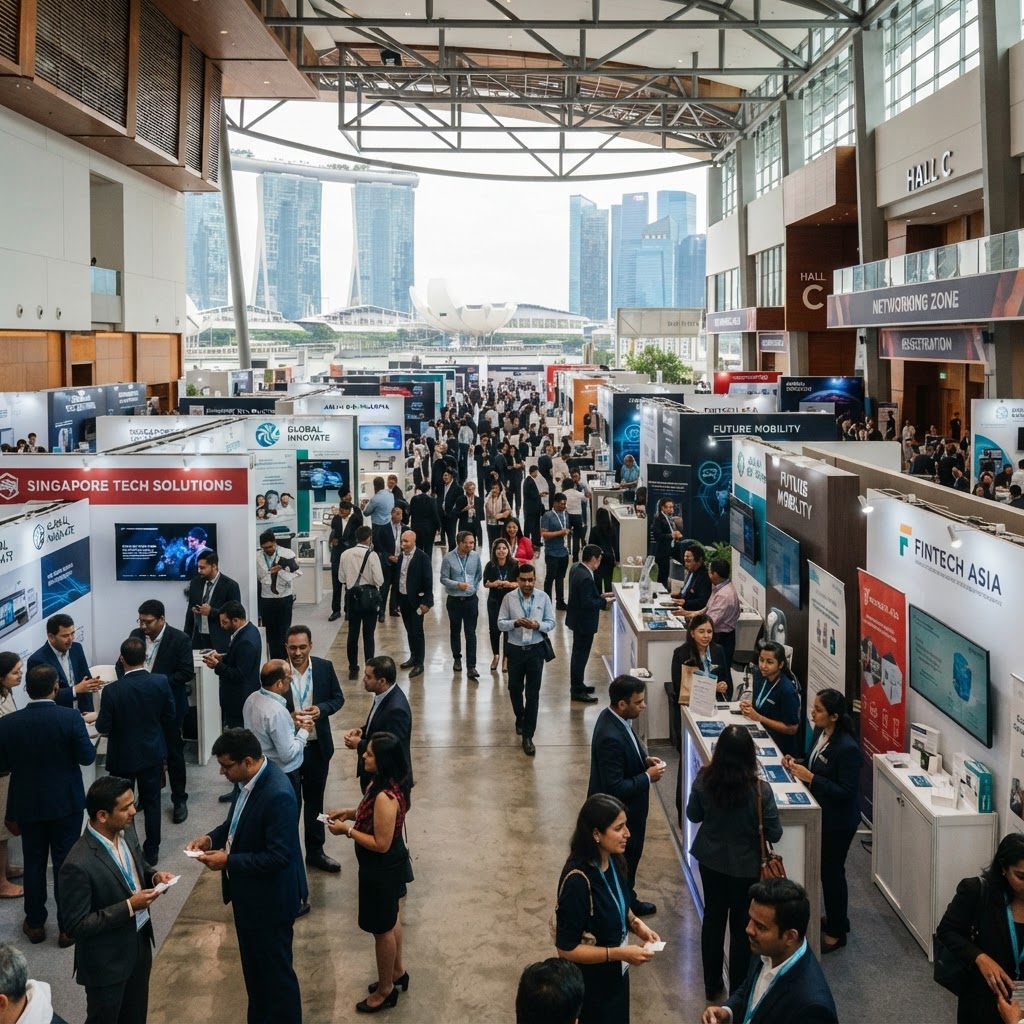
Exhibiting in Singapore: A Practical Guide for Overseas Brands
Singapore is Asia's most accessible trade show destination for overseas exhibitors. With world-class venues, a business-friendly regulatory environment, and a strategic location at the crossroads of Southeast Asia, it offers the lowest barrier to entry for brands testing the Asian market. But the ease of doing business in Singapore comes with high costs and intense competition for attention. This guide walks you through everything you need to know to exhibit successfully in Singapore.
Why Exhibit in Singapore?
Singapore hosts over 3,500 trade events annually, drawing exhibitors and buyers from across ASEAN, China, India, and beyond. The city-state's connectivity — Changi Airport serves 400+ cities — means your target buyers can reach the show with minimal friction.
Key advantages:
- English is the working language. Contracts, signage, negotiations, and show documentation are all in English. This removes the translation layer that complicates shows in Thailand, Vietnam, or Indonesia.
- Transparent regulations. Customs procedures are predictable, GST is straightforward (7%), and temporary imports under ATA Carnet are well-supported.
- Premium audience. Singapore shows attract senior decision-makers and regional procurement managers. You'll meet buyers who control budgets across Southeast Asia, not just the local market.
- World-class venues. Singapore Expo and Marina Bay Sands are among Asia's best-equipped exhibition spaces, with reliable power, fast Wi-Fi, and professional on-site services.
Choosing the Right Show
Singapore's major exhibitions span industries from medical technology to food and beverage. Here are the anchor shows to know:
| Show | Industry | Venue | Typical Attendance | |------|----------|-------|-------------------| | FHA (Food&Hotel Asia) | F&B, hospitality | Singapore Expo | 45,000+ | | Asia Tech x Singapore | Technology, telecoms | Singapore Expo | 15,000+ | | Medical Fair Asia | Medical, healthcare | Marina Bay Sands | 25,000+ | | BuildTech Asia | Construction, building tech | Singapore Expo | 12,000+ | | Cosmoprof Asia SEA | Beauty, cosmetics | Marina Bay Sands | 20,000+ | | Industrial Transformation ASIA-PAC | Manufacturing, Industry 4.0 | Singapore Expo | 18,000+ |
Selection tip: Check if the show is endorsed by Singapore's Exhibition & Convention Bureau (SECB). Endorsed shows receive government support, which typically means higher quality and larger international pavilions.
Venue Logistics
Singapore Expo
Located in Changi, about 20 minutes from the airport and 25 minutes from the CBD. Ten halls totalling 100,000 sqm of indoor space. Well-served by MRT (Expo station on the East-West Line). Ample parking, on-site catering, and dedicated freight access.
Marina Bay Sands (MBS) Expo & Convention Centre
Downtown, integrated with the hotel and casino complex. 250 meeting rooms and four exhibition halls. Smaller than Expo but more prestigious — better for B2B shows where image matters. Limited freight access compared to Expo, so plan move-in times carefully.
Key Logistics Notes
- Move-in: Typical move-in windows are 8am–6pm the day before the show opens. Check your contractor's hall access time — some halls have staggered slots.
- Power: 230V, 50Hz, Type G plugs (UK-style three-pin). Standard shell scheme usually includes one 13A power point. Custom booths should plan power distribution early.
- Rigging: Both venues have height restrictions. Singapore Expo allows up to 6m in most halls; MBS is more restrictive. Submit rigging plans to the organiser at least 4 weeks before the show.
- Wi-Fi: Free public Wi-Fi exists but is unreliable during peak hours. If you need dedicated connectivity for demos or lead capture, book a dedicated line from the venue.
Customs and Temporary Import
Singapore makes temporary imports straightforward. Two options:
ATA Carnet
Singapore accepts ATA Carnet for temporary imports of exhibition goods, display materials, and equipment. This is the simplest path — no duties, no complex paperwork. Apply through your national chamber of commerce before departure.
Temporary Import (TI) Scheme
If you don't have a Carnet, you can use Singapore Customs' TI scheme. A local customs broker (typically arranged by your freight forwarder) posts a security deposit equal to the GST on your goods. The deposit is refunded when goods are re-exported within 3 months.
Pro tip: Samples given away or consumed at the show (food tasting, product samples) may be subject to GST. Budget for this — it's often overlooked.
Booth Design for Singapore
Climate Considerations
Singapore is 1° north of the equator. It's hot (30–33°C), humid (70–85% RH), and rains frequently. Your booth materials need to handle this:
- Use moisture-resistant materials. MDF and untreated wood will warp. Opt for aluminium framing, acrylic panels, and laminated surfaces.
- Ventilation matters. Convention halls are air-conditioned, but entrance areas and perimeter booths can get warm. If your booth is near an entrance, include a fan in your build plan.
- LED lighting is essential. Bright, evenly lit booths stand out. Singapore shows are competitive — under-lit booths get ignored.
Design Standards
Singapore exhibitors tend toward clean, modern aesthetics. Visitors expect professional presentation. Key design priorities:
- Signage in English is sufficient for most shows. If you're targeting buyers from China or Indonesia, consider bilingual signage for those specific markets.
- QR codes are ubiquitous. Singapore visitors are comfortable scanning for information, brochures, or lead capture. Make QR codes a core part of your booth design.
- Reception counter height: Standard is 1.1m. Taller counters create a barrier; lower ones feel more welcoming.
Shell Scheme vs Custom Build
Most Singapore shows offer shell scheme packages (typically 3m × 3m or 3m × 2m modules). If budget allows, a custom build will differentiate you — but costs run SGD 8,000–25,000 for a standard 18sqm booth versus SGD 2,500–4,000 for a shell scheme upgrade.
Staffing Your Booth
Singapore's multilingual, multicultural audience means your team needs flexibility:
- English is essential. All staff should be comfortable presenting in English.
- Mandarin is a strong second. Many buyers from China, Taiwan, and even local Singaporean Chinese businesspeople prefer Mandarin for relationship-building.
- Business attire: Business casual is standard. Full suits look out of place at most Singapore shows (the heat makes this impractical anyway). A neat polo or button-down with trousers works well.
- Greeting etiquette: A firm handshake and direct eye contact are standard. Singapore is direct and transactional — small talk is brief and business-focused.
- Name cards: Still important in Asia. Have your team carry cards (English front, optionally Mandarin back) and exchange them with two hands.
Lead Capture and Follow-Up
Singapore's digital-first business culture makes lead capture straightforward:
- QR code lead capture is the norm. Use a tool like BadgeTap, CompuSystems, or the organiser's app to scan visitor badges directly.
- WhatsApp is the dominant messaging platform in Singapore (80%+ penetration). Ask visitors for their WhatsApp number during the conversation — it's more effective than email for follow-up.
- Email follow-up within 48 hours is expected. Singapore buyers are prompt and expect the same.
- LinkedIn is strong for B2B. Connect with senior contacts on LinkedIn within a week of the show.
Budgeting
Singapore is the most expensive exhibition destination in Southeast Asia. Here's a realistic budget for a 6m × 3m (18sqm) custom booth at a major Singapore show:
| Item | Cost (SGD) | |------|-----------| | Space rental (18sqm @ SGD 550/sqm) | 9,900 | | Custom booth build | 12,000–18,000 | | Shell scheme upgrade (alternative) | 2,500–4,000 | | Freight and customs (ATA Carnet) | 2,000–4,000 | | Travel and accommodation (3 staff × 4 nights) | 6,000–8,000 | | Marketing collateral and giveaways | 2,000–3,500 | | Lead capture and tech (QR codes, iPads) | 500–1,000 | | On-site catering and hospitality | 1,000–2,000 | | Total (custom build) | 33,400–46,400 | | Total (shell scheme) | 23,900–32,400 |
Cost-saving tip: If this is your first Singapore show, start with a shell scheme upgrade. Invest the savings in better graphics, more staff, and post-show follow-up. You'll learn more from the show and spend 30% less.
Common Mistakes to Avoid
- Underestimating humidity. Materials that work in Europe or North America may warp or degrade in Singapore. Always specify climate-appropriate materials.
- Skipping the organiser's briefing. Singapore show organisers run detailed pre-show briefings (usually via Zoom) covering move-in, regulations, and local requirements. Attend them.
- Not booking accommodation early. Major shows push hotel rates up 200–300%. Book at least 3 months ahead — or use the organiser's partner hotels for better rates.
- Ignoring the regional audience. Most Singapore show visitors are not local — they fly in from across ASEAN, China, and India. Prepare your pitch for a regional audience, not just Singapore.
- No follow-up plan before arriving. Leads go cold fast. Have your WhatsApp and email follow-up templates drafted before you arrive, and send the first round within 48 hours.
Final Thoughts
Singapore is the ideal first step into Asian trade shows. The infrastructure is world-class, the business environment is transparent, and the audience is regional. But the costs are high and competition is fierce. Success comes from treating Singapore not as a standalone market but as a gateway — the buyers you meet there represent opportunities across all of Southeast Asia.
Plan your budget carefully, invest in good design, staff with people who can build relationships across cultures, and follow up fast. Do that, and your Singapore exhibition will deliver returns that extend far beyond the show floor.